.png)
Reclaiming Human Agency in the Age of AI Agents

Updated: Aug 3
Insights
AI readiness & productive scepticism: AI readiness isn’t only about technical literacy but also intent. Many organisations were already using AI, but the more meaningful question was not whether they knew how to use it, but what problems were worth applying it to. Distrust around hallucinations, verifiability, and misuse did not need to be removed; when surfaced openly, it became the basis for more responsible experimentation. | Judgement as the new scarce resource: As AI lowers barriers to building websites, dashboards, and tools, the scarce resource shifts away from production and toward problem framing, critical thinking, contextual judgement, and the ability to ask better questions. | The illusion of insight: Many organisations are not short of data, but short of the systems, habits, and analytical capacity needed to convert data into insight. AI can intensify this by producing coherent outputs that create the appearance of insight before the harder work of reasoning has taken place. | Ground truth and invisible decay: In the AI era, organisations closest to communities become more valuable because they generate fresh, grounded data. If this work weakens, systems may continue producing fluent outputs long after their underlying understanding of reality has begun to drift. |
What AI should and should not do: Structured, repetitive, rule-based tasks often lend themselves well to AI. But work involving nuance, ethics, monitoring frameworks, external communication, and contextual trade-offs remains difficult to automate and continues to require human interpretation. | From users to builders: Natural-language interfaces and agents reduce dependence on technical gatekeepers, allowing non-technical users to prototype solutions directly. Progress often came not from mastering the system, but from learning to question it, redirect it, and treat it as a fallible assistant rather than an authority. | Abundance creates fragmentation: As barriers to building fall, the problem may shift from scarcity of tools to an overabundance of disconnected ones. Rapid experimentation can generate parallel systems solving similar needs without coherence, interoperability, or shared learning. | From tools to shared infrastructure: If tools become easier to create and easier to discard, long-term value moves toward shared processes, reusable foundations, legible systems, and communities building in relation to one another rather than in isolation. |
Context
For a long time we’ve been asked by nonprofits if we do AI sessions, and we kept wondering, to what end? If the intention was simply to learn AI, it felt insufficient. There was a sense that more introspection was needed before the conversation could be worth having. We were perhaps waiting for a time when this would cease to feel like a trend to keep pace with and become a tool for more deliberate engagement.
Insight Out emerged at a point where the AI wave had settled enough for us to ride it and we started imagining the possibilities that could arise out of doing so.
Introduction
The day kickstarted with a quick poll that helped gauge everyone’s experience and levels of trust, curiosity, and frustration with AI. Concerns were welcomed, and participants shared how they use AI within their organisation and in situations where it didn’t fit their use case. Skepticism was the most consistent emotion in the room and though by the end of the workshop, it had not disappeared, it had shifted towards a growing willingness to experiment.
This in many ways was the purpose of Insight Out i.e. to place the concerns around AI in a more informed context. Questions of verifiability, mistrust, and hallucinations were purposely surfaced, with the aim to understand what responsible use might look like in practice, and where the real challenges lie.
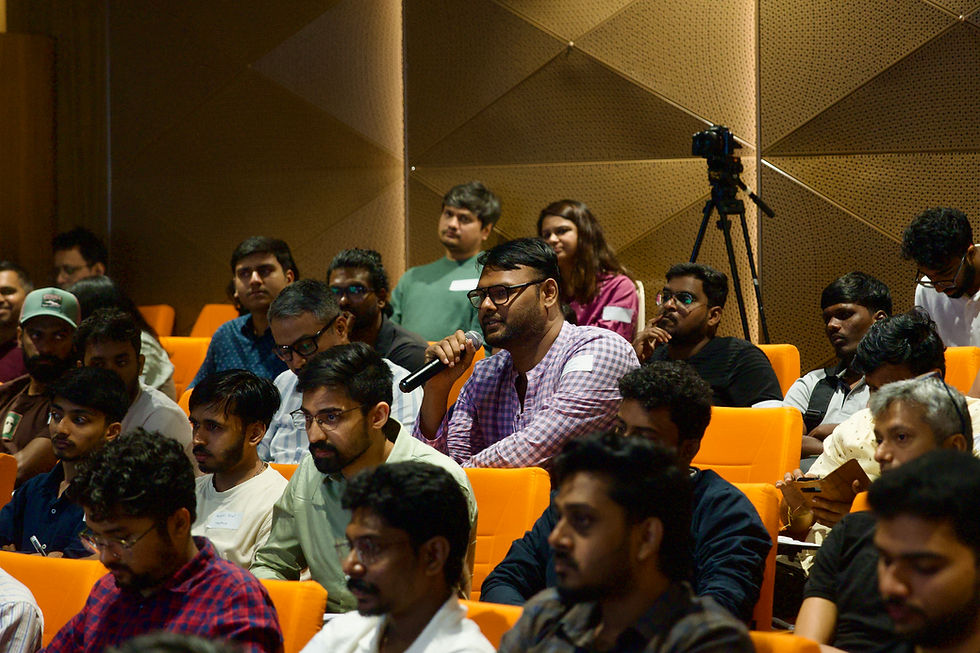
The workshop, held in Bangalore on March 27th, 2026, brought together 33 organisations and 69 participants. Huge shout out to Samagata and Mphasis for their support in making it happen. The first half of the day focused on orienting the room to the fundamentals and choices surrounding AI. The second half opened into an unconference, where problem statements were unpacked and groups began building or testing ideas using Antigravity.
What has changed
Building on this early momentum, Dr. Kailash Nadh, Co-Founder Rainmatter Foundation & Samgata Foundation; CTO, Zerodha took the stage to situate what, precisely, has changed with the advent of AI. Tasks that once required specialised teams; cleaning datasets, building dashboards, developing websites, are now only a few prompts away. Code, he suggested, is no longer the scarce resource it once was, coding agents have reached a level of fluency where they can produce working systems with considerable accuracy.
What remains scarce is critical thinking. The ability to define a problem well and ground-truthed data that reflects the lived complexities of the social sector. These, he emphasised, are not replaceable.
The sector is using AI
Most organisations in the room were already using AI but where the benefits were immediate; to write proposals faster, clean documents, generate training material, or assist with code. U&I Trust is building learning systems with Claude. NalandaWay is integrating AI across scope writing, financial validation, and prototyping. Others are assembling workflows that would have been difficult to attempt even a year ago.
This marks a significant shift for a sector accustomed to incremental progress and constrained by lean teams. Turnaround times are shrinking and output is increasing.
But is this speed concealing its own costs? The same system that drafts a proposal can also introduce details that were never there and though models are structuring information, they are flattening what made it specific or indeed grounded.
Hallucinations surfaced early in the discussion and not as an abstract or technical concern, because when the output feeds into funding, policy, or public narratives, such errors can have consequences.
What unsettled people was not just that AI makes mistakes but how convincingly it does so; outputs are mostly coherent, well-phrased and internally consistent.
There is very little in the output itself that signals doubt and unless one already knows what is missing, the error passes unnoticed. Over time, that shifts how people read. Verification becomes selective and when seen cumulatively, the “truth value” of information begins to erode
But the real problem was already there
It is tempting, at this point, to locate the problem in the technology itself but the more difficult insight is that the problem was already there.
Organisations are not short of data. They collect it consistently, often with considerable effort. What is less common is the ability to derive insight from it.
A third of participants in the room said they struggle to move from collection to interpretation. There is information, but not always clarity about what it is saying.
In this context, the way AI is being used becomes revealing.
Reclaim Constitution described using it largely for formatting rather than analysis. Formatting works because it does not interfere with thought, but rather makes ideas easier to express, what it however does not do, is help decide what those ideas are. The human remains responsible for such meaning.
And to arrive at said meaning, we require judgement, context, and a sensitivity to what is absent as much as to what is present. AI is not built for this kind of patience. Its strength lies elsewhere, in moving quickly from data to pattern, from pattern to answer. It produces rushed clarity.
This is where the earlier concern around hallucinations returned in a different form. The risk is not only that AI produces incorrect information, it is that it produces convincing interpretations in the absence of well-formed questions. The appearance of insight begins to replace the process of arriving at one.
The role of ongoing data collection
Which leads us back to a crucial strength that the social sector holds, one that is easy to overlook in the current moment, that of data collection rooted in proximity, continuity, and lived engagement, something AI, for all its fluency and speed, cannot replace. AI systems rely on existing datasets, and in the social sector those datasets are built slowly, often painstakingly, through fieldwork, documentation, and sustained engagement with communities whose realities do not easily compress into clean variables.
When this process weakens, nothing breaks in any immediately visible way. The system continues to respond, outputs remain structured, patterns appear intact, and there is little in the surface behaviour of the tool to suggest that anything has changed at all but underneath, what the system is describing starts to drift.
You can still ask questions, and they can be as complex and as urgent as before. About climate patterns across regions, about livelihoods under stress and the answers will come back fluent and persuasive but on a closer look or sometimes not even then, one realises they are built on a version of reality that has aged out of relevance, and because the degradation is gradual, it poses a very real risk.
If organisations closest to the ground, nonprofits and community-based groups who generate primary data through direct engagement, begin to scale down this work, then over time the very information systems we rely on to understand development realities begin to thin out.
This also brought into focus a more practical distinction. Not all tasks lend themselves equally to AI. Where work is structured, repetitive, and based on clear rules, the system performs with a certain reliability. But where nuance, context, and judgement are central, particularly in areas like writing, monitoring and evaluation frameworks, or other forms of external communication, the limitations become harder to ignore. Participants shared instances where outputs, though well-formed, failed to hold up under scrutiny, revealing gaps that required human interpretation to resolve.
What began as a conversation about data, then, gradually widened into a question about the boundaries of the system itself. Not just what it can do, but what it should be trusted to do, and where the responsibility must remain human. And it is at this point that the limitation began to take on a different significance.
From chatbots to agents: Reclaiming the human
Kailash’s next session shifted the frame from chatbots to agents.
AI, he reiterated, is not intelligence in the way people often imagine it. It is software working over data, generating outputs based on patterns. It is probabilistic, uneven, and capable of being wrong in ways that are not immediately apparent. This framing took AI out of the realm of the exceptional and placed it back within reach. Something that must be examined, questioned, and, where necessary, corrected. So that, once we treat the system as not authoritative, then the responsibility for judgement returns to the user.
It is within this frame that the shift from chatbots to agents becomes meaningful. Most participants were familiar with chat-based interfaces. Agents introduced a different mode of interaction. They can access local resources, retrieve and analyse information, and execute tasks through a continuous loop of reasoning and iteration.
The engagement no longer remains a conversation. It becomes a system that works through a problem in steps, refining its output along the way.
On openness, in an age of agents
If much of the day was spent understanding what AI can do, this part of the conversation turned toward what should remain shared. T4GC and OASIS have long championed the use of open source technology within the social sector, not simply as a cost-saving measure, but as a philosophy of building. Openness allows for collaboration, for longevity, replication and adaptation of tools across contexts that rarely remain static. It offers a way to build infrastructure that is not locked into a single vendor, but instead remains accessible to those who need it most.
With the rise of coding LLMs and agentic tools, the act of building itself has changed. Organisations are no longer as dependent on specialised technical skills to create functional systems.
It is now possible to build tools that respond to highly specific, localised needs, and just as easily retire them when those needs evolve or disappear. In that sense, technology becomes more temporary, more situational.
But this only sharpens the importance of what is shared.
If tools themselves are no longer the primary constraint, then the value begins to move elsewhere. Toward processes. Toward ways of thinking through problems, data, insights, and approaches that allow others to build, adapt, and respond in their own contexts.
The role of open source, then, becomes more foundational.
Because while individual tools may come and go, the need to build collectively, to avoid fragmentation, and to contribute to a shared pool of knowledge remains unchanged.
If anything, it becomes more urgent in a landscape where the barriers to building have been lowered, but the risk of working in isolation has increased.
From prompting to building
It is against this backdrop that the workshop moved from discussion into practice.
The hands-on session followed. Through a series of small demonstrations, participants were guided through tasks that would have once required technical teams. Building a simple website, extracting answers from datasets, identifying patterns in information that had previously remained unused.
All of this was done using Antigravity, an agentic interface that participants had been asked to install prior to the session.
Often described as “vibe coding,” a term popularised by Andrej Karpathy, this approach allows individuals to work through problem statements using natural language, iteratively prompting systems to move toward an outcome. The process itself was straightforward, participants began with an outcome in mind, provided data that contains or relates to that outcome, prompted the system and then went on to refine, adjust, and iterate based on what it returned.
What would earlier have required the translation of ideas into technical specifications could now be expressed directly. When questions arose, even around something as specific as hosting what had been built, the system itself could guide the next steps, responding to intent rather than vocabulary.
The day, however, did not fully take shape until participants began to really wade through their own problems.
With only a basic structure to guide them, nonprofit representatives started applying these tools to datasets and questions drawn from their own contexts. They worked with non-sensitive, mission-relevant data, attempting to aggregate results, uncover insights, detect patterns, and build small, functional applications.
What stood out was how people were approaching the process. There was a visible shift in posture. Curiosity began to take precedence over hesitation. The scepticism that had defined the morning loosened its hold, making space for exploration.
Here is when another shift became visible, people in the room started realising they could peel away the interference and noise from a system that had, until recently, been tuned for a technical audience.
At first they paused when the agent said things like "you need an api key" or returned dense errors. The instinct to lean on someone more technical was perceptible, but this had already been anticipated. Instead of stepping in and having them leave the room thinking "I needed an engineer to help with that" we asked them to push back. To not try to decode it, just say "I don't understand, find another way" or "try harder please".
This strategy once attempted made participants perceive the problem differently. They saw the machine less as a machine and more as an assistant. Albeit a sharp young intern speaking a new slang.
And with that shift in place, the problem itself started to look different. The non-technical user could move into a space that previously felt closed, while the technical folks could, perhaps for the first time, step back from execution and observe how people actually interacted with these systems, not as expected or intended, but as experienced first hand, dislodging another essential realisation, one around the systemic, philosophical and ethical implications of the technology itself.
After a few hours of individual work, participants moved into groups.
The unconference format created room for something less structured as people began to share not just outputs, but problem statements. They compared approaches, questioned assumptions, and, in many cases, found overlaps across domains that had previously seemed unrelated.
There was a range of reactions in the room. Moments of excitement, confusion, isolated concentration, and occasional laughter as systems responded in unexpected ways.
Some of what participants shared captured this shift more directly:
“It feels like us kids got toys.”
“I’ve completed my milestone for the year.”
“Using AI, I’ve built a tool in a few hours where I can start the conversation at a point people are interested in, and then take it into the web of interconnections, which people often struggle to understand in climate stories.”
“The peripheral benefit was that I got to explore another organisation’s problems, and that gave me a completely different set of ideas. The peer learning mattered as much as the tool.”
Alongside the outputs, Insight Out, had engineered a cross-sector exchange. Participants were learning as much from each other’s questions as from their own attempts at solving them.
In that sense, what the workshop produced was not just a set of tools or use cases.
This workshop was a glimpse into what becomes possible when the distance between identifying a problem and attempting to respond to it begins to shrink.
What people built
By the end of the day, what emerged from the room was, on the surface, uneven. Some outputs were partial, others fragile, a few already beginning to resemble something usable. But to focus on their completeness would be to misunderstand what had taken place.
A system to connect related news stories, where human review remained necessary. A tool to identify locations that required clean-up. A platform that could help a user find organisations aligned with their interests. A multilingual framework for impact assessment. A dashboard on foundational literacy and numeracy, intended not for display but for informing policy.
None of these were presented as breakthroughs. They did not carry the language of innovation that so often accompanies technology.
They were, more simply, responses to fragmentation and to the difficulty of navigating information that exists but does not yet cohere and more importantly perhaps, the persistent problem of access, where knowing something exists is not the same as being able to use it.
This distance, for a long time, as we at T4GC only know too well, has been one of the defining constraints of the sector. Ideas required translation into technical language, resources had to be secured, time passed between intention and action, often enough for the urgency of the problem to shift or dissipate, secondary as it was to the more pressing programmatic work of organisations.
What this workshop was able to modestly achieve was a contraction of that space.


Comments